
RV owners who move to the Gulf Coast from drier parts of the country usually find out the hard way: the maintenance rules change down here. The heat, humidity, and salt air that make South Alabama worth living in are also the exact conditions that accelerate wear on the rubber and caulk seals that keep your motorhome watertight. And unlike a flat tire or a dead battery, seal failure tends to happen quietly — until one season of storage turns into a mold-covered interior and a five-figure repair estimate.
If you store your RV near Fairhope or anywhere in Baldwin County, here's what you need to know about how the local climate affects your seals, what to watch for, and how to stay ahead of it.
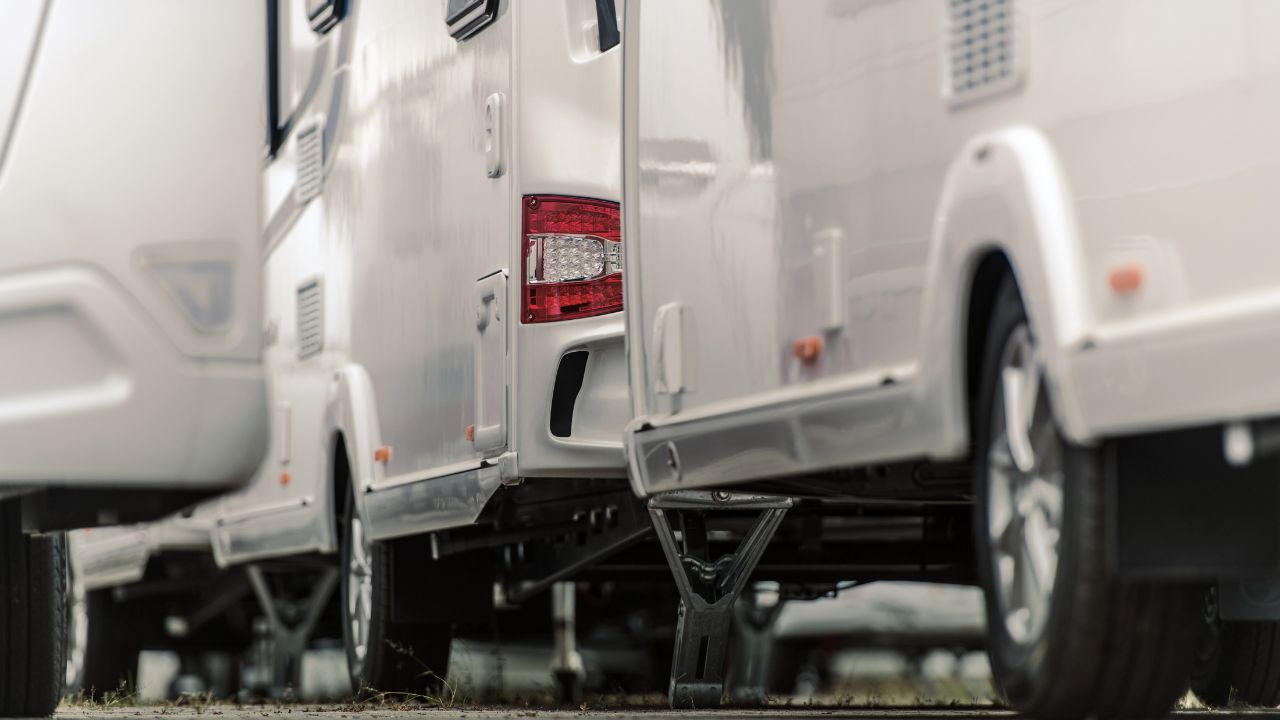
Most RV maintenance guides are written for a general national audience — which usually means dryer climates like the Southwest or the Midwest. The Gulf Coast is a different environment entirely, and it stresses RV seals in ways those guides don't fully account for.
Fairhope averages relative humidity above 70% for most of the year, with peaks in the summer months pushing into the 80s and 90s. That sustained moisture puts constant pressure on every rubber gasket, foam seal, and caulk joint on your RV. Rubber that stays damp for extended periods breaks down faster than rubber in arid climates — it loses elasticity, develops micro-cracks, and eventually fails to create a watertight bond.
The Gulf Coast sun hits at a lower latitude than most of the country, meaning UV exposure is more intense and more consistent. UV radiation is the primary cause of rubber oxidation — the process that turns seals chalky, stiff, and cracked. If your RV sits outside without a cover, the combination of heat, UV, and humidity accelerates seal degradation significantly compared to northern storage conditions.
If you've spent time near Mobile Bay or the Gulf, your RV has picked up salt air even if you haven't noticed. Salt is hygroscopic — it attracts and holds moisture — which means metal hardware around seals (screws, trim pieces, roof fixtures) corrodes faster, and that corrosion can compromise the seal bond around them.
Baldwin County doesn't get the hard freezes that destroy seals in the Midwest, but it does cycle through wide temperature swings — especially between summer highs and winter nights in the 30s. Each cycle causes seals to expand and contract. Over time, that movement creates gaps and micro-cracks, even without a single hard freeze.
Not all seals fail at the same rate. Knowing which ones to inspect first can save you from discovering a problem only after water damage has already set in.
The roof is the highest-priority area on any RV stored in a humid, high-UV climate. Every roof penetration — vents, air conditioner bases, antennas, skylights — is sealed with either rubber gaskets or lap sealant. Lap sealant has a lifespan of roughly three to five years under typical conditions; in Gulf Coast conditions, you may see degradation in two to three years, especially on south-facing roof surfaces. Look for:
Slide-out seals — the rubber wiper seals and D-ring gaskets that run along the edges of each slide — are constantly compressed and released. In high-humidity conditions, rubber that stays compressed for extended storage periods can take a permanent set, meaning it no longer springs back properly when the slide extends. This leaves gaps where water and insects can enter. If your RV sits in storage for more than two months, extend and retract the slides periodically to keep the seals from setting in the compressed position.
Window frame seals and door gaskets are often overlooked because they're not on the roof, but they're exposed to the same UV and humidity cycle. A failed window seal is one of the most common entry points for moisture in stored RVs. Run your hand along the interior edge of windows and doors after a rain and feel for any dampness or soft wall material around the frame.
The rubber gaskets around exterior basement storage doors take constant abuse from road grit, UV, and weather. In humid climates, moisture enters through even small gaps and sits in enclosed spaces, leading to mold and corrosion on stored items and compartment walls. Check for tears, flat spots, and areas where the gasket has pulled away from the door frame.
The fittings and seals around fresh water tanks, water heater enclosures, and drain connections can soften and swell in extreme heat, then dry out and crack when stored without water pressure. For long-term storage, draining the system completely is the best way to prevent pressure-related seal failure.
Make a roof inspection part of your pre-storage routine every year — not every few years. Walk the roof, check every seal point, and probe any area that looks dull, cracked, or separated. The cost of a tube of lap sealant and an hour of work is nothing compared to water damage remediation, which can run $3,000 to $15,000 depending on what gets affected.
Not all RV lap sealants are equal. In high-UV, high-humidity conditions, look for a self-leveling silicone-based or polyurethane sealant rated for UV resistance. Avoid acrylic caulk — it dries out and cracks faster in heat. Dicor and Geocel 2300 are both widely used and hold up reasonably well in Southern climates.
Rubber protectants like 303 Aerospace Protectant condition the rubber and add a UV barrier that significantly extends seal life. Apply it to slide-out seals, window gaskets, door seals, and any exposed rubber trim at least twice a year — before summer and before any extended storage period.
UV damage is cumulative and unavoidable if your RV sits outside without protection year after year. A quality breathable RV cover significantly reduces UV exposure on roof seals and exterior caulking. Even better: covered storage eliminates the UV exposure entirely, keeps rain off the roof seams, and dramatically extends the time between seal replacements. For RV owners in Fairhope and Baldwin County, covered RV storage is one of the most cost-effective maintenance decisions you can make.
A sealed, unventilated RV interior in Gulf Coast humidity becomes a moisture trap. Even with good exterior seals, ambient humidity can build up inside, causing condensation on interior surfaces and accelerating deterioration of foam seals and interior gaskets. Leave interior cabinet doors slightly open and use a roof vent cover that allows passive airflow without letting rain in. A couple of DampRid containers placed inside makes a real difference.
If your RV will be in storage for more than 60 days, plan a check-in that includes extending and retracting the slides. This prevents the rubber wiper seals from taking a set in the compressed position and helps maintain an even seal contact all the way around. It's also a good opportunity to apply protectant while the full seal surface is exposed.
In drier climates, RV owners often wait until they see a problem before re-caulking. In Gulf Coast conditions, proactive re-caulking every two to three years on high-exposure areas (roof penetrations, slide-out corners, window frames) is the smarter approach. Catching a seal before it fully fails costs almost nothing. Catching the water damage that follows costs a lot.
If you're inspecting a stored RV and you're not sure whether seal failure has already caused damage, here's what to look for inside:
If you find any of these signs, address the source seal first and then assess the damage. Small areas of water-damaged wall material can sometimes be replaced without a full interior gut — but only if caught early.
At minimum, do a full roof and exterior seal inspection once a year — ideally before you put it into extended storage. In high-UV, high-humidity conditions like Baldwin County, checking every six months is even better. It takes less than an hour and is the single highest-return maintenance task you can do.
Silicone-based and polyurethane sealants outperform acrylic in heat and UV exposure. Dicor lap sealant and Geocel 2300 are common choices. Avoid standard white caulk — it dries out and cracks much faster in Southern conditions.
Indoor covered storage significantly reduces UV damage, but very high ambient humidity can still affect rubber seals over time — particularly slide-out seals and interior gaskets. Ventilating the interior and using moisture absorbers helps even in covered facilities.
Check for soft or spongy walls, staining on interior panels, a musty smell, bubbling or delaminating exterior fiberglass, and soft spots in the floor. Any of these warrants a closer inspection before you assume the seals are fine.
In the Gulf Coast climate — yes. UV exposure is the primary cause of premature seal degradation, and covered storage eliminates it entirely. If it extends the time between roof recaulking from every two years to every four or five, it pays for itself many times over, not counting the water damage it prevents.
At Sweetwater Solutions, we offer covered and uncovered RV storage in Fairhope, AL, with unit sizes to fit everything from travel trailers to full Class A motorhomes. Our facility on AL-181 gives you easy in-and-out access without fighting Daphne traffic — and covered options that give your seals a fighting chance against the Gulf Coast sun.
Give us a call or stop by and we'll walk you through what's available.
Sweetwater Solutions
16210 State Highway 181, Fairhope, AL 36532
251-210-6500
Preparing for long-term storage? See our guide: How Long Can You Store an RV? Tips for Long-Term Motorhome Storage.